Terrane-aware lunar metallurgy — WAMS 2026
LP-GRS chemistry → terrane labels, resource indices, alloy/process maps. Analysis code for WAMS 2026 paper
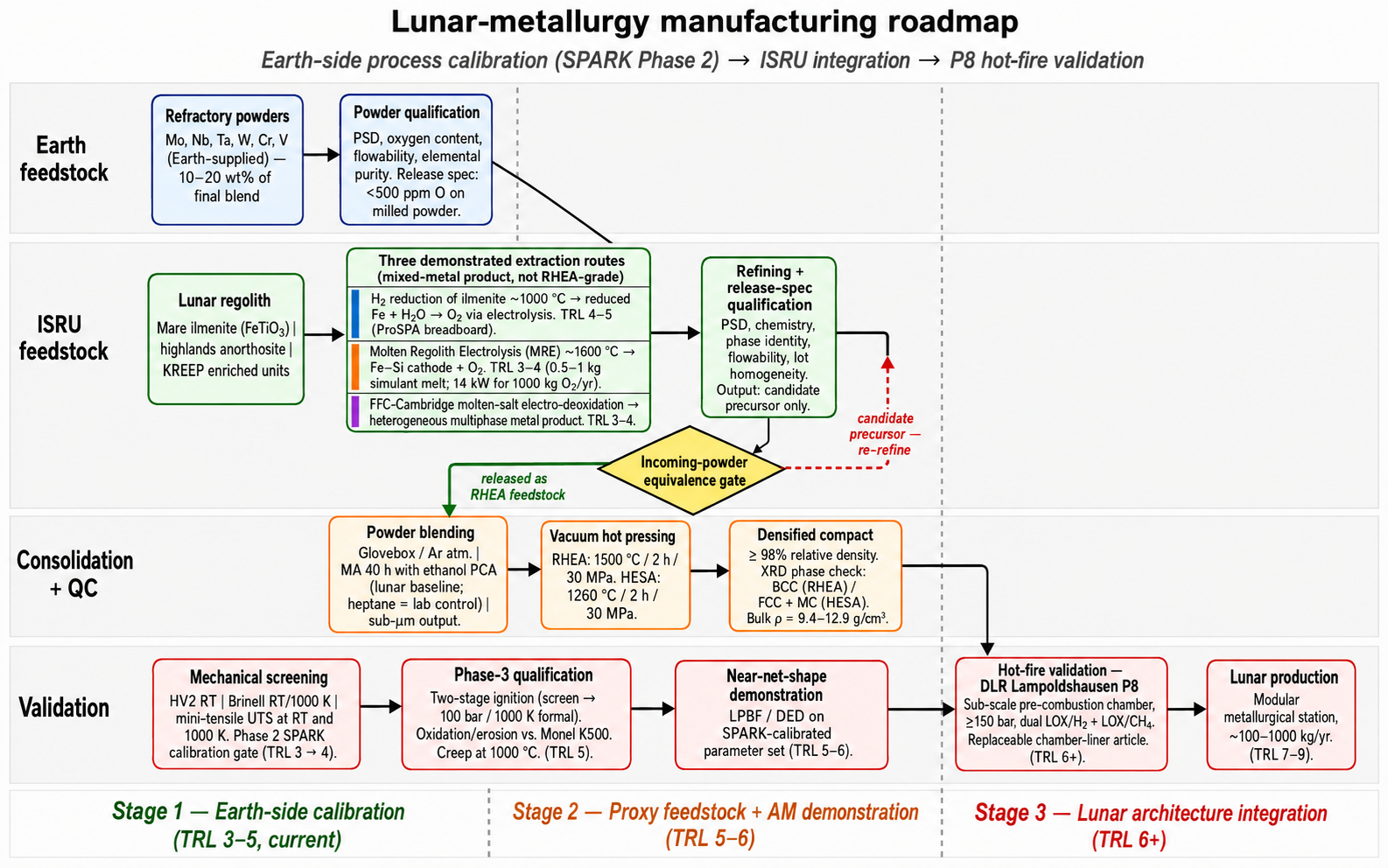
Companion code for WAMS 2026 Paper #68: Refractory High-Entropy Alloys and Hybrid Additive Routes for Metallurgy in Lunar Mare, Highlands and KREEP Terranes (S. Y. Kovid and K. Gruning, Bimo Tech).
Setup
Mare, highlands, and KREEP have different oxide / trace budgets, so alloy and process choices differ by terrane. This pipeline maps Lunar Prospector GRS chemistry into terrane labels, metallurgical indices, and manufacturing-relevant figures for the paper.
Pipeline
Input: LP-GRS elemental abundances (~11k equal-area 2° pixels — FeO, TiO₂, Al₂O₃, CaO, MgO, SiO₂, K/Th/U).
- Preprocess — CLR, imputation, terrane classification
- PCA / clustering — loadings, silhouette / DBI
- Indices — I_FeTi, I_AlCa, I_KREEP
- Compatibility — terrane → alloy / process mapping
- Thermo — binary and RHEA phase diagrams (pycalphad, COST 507 / published
.tdb)
Example run counts: ~8.5k highlands, ~1.2k mare, ~1.6k KREEP; silhouette ≈ 0.37, DBI ≈ 1.14.
Repo map
notebooks/wams2026_pipeline.ipynb— data → PCA → indices → mapsscripts/— Monte Carlo sensitivity, break-even panels, dilution / RHEA diagramsphase_diagrams/— Fe–Ti, Al–Fe, Al–Ti, Al–Ni; HfNbTaTiZr / MoNbTaTiVfigures/— paper figures (roadmap PNG above; most others PDF)
LP-GRS provenance: data/DATA_SOURCES.md (NASA PDS; Prettyman et al. 2006).